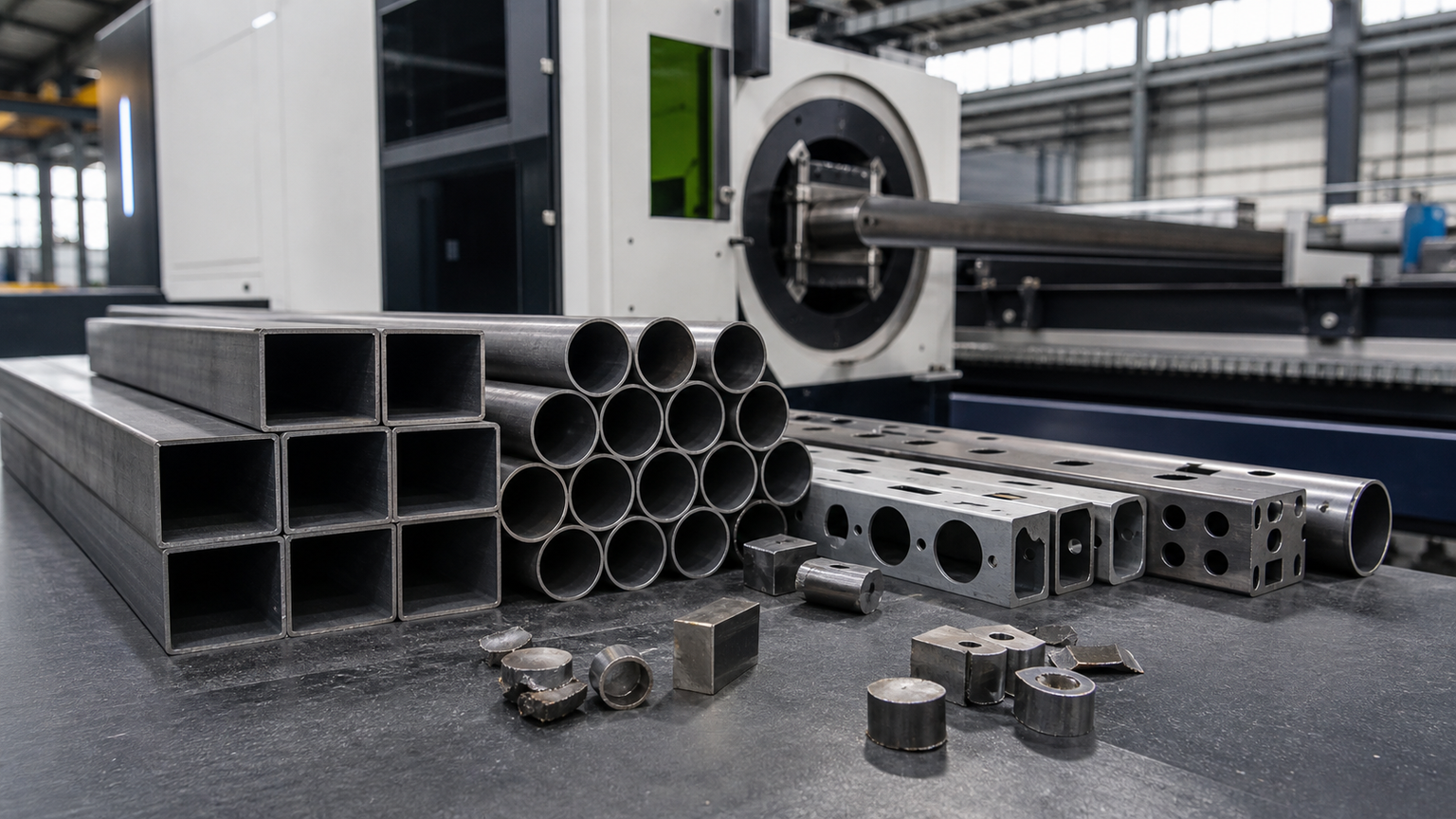
A buyer evaluating high-volume tube laser cutting usually sees tail waste as a normal cutting loss, especially when each individual remnant looks small. The risk is that marketing pages may emphasize cutting speed, laser power, or “zero-tail” slogans while leaving the real cost drivers unclear: chuck grip length, machine dead zones, front-first cutting sequence, nesting limits, part mix, and whether the claimed saving applies to the buyer’s tube sizes and order patterns.
The right evaluation question is: how should buyers verify whether a zero-tail tube cutting machine can actually improve material utilization before RFQ? Buyers can check public product descriptions, machine architecture diagrams, cutting process videos, sample nesting logic, stated chuck configuration, published case materials, patent or technical documentation if available, and quality-system signals. But these sources only establish a baseline; tail-waste reduction, utilization rate, cycle time, and profitability remain unresolved checks until the supplier proves them with the buyer’s own tube profile, length, wall thickness, part geometry, batch size, and acceptance criteria.
This article separates what can be verified from public information, what remains only partially supported, and how buyers should convert each uncertainty into RFQ-stage questions, sample tests, and factory-audit checks.
What public evidence can verify zero-tail tube cutting capability?
A supplier claims its machine reduces or eliminates tail waste, but you cannot tell whether the claim applies to your tube diameter, chucking method, part length, or production mix. If you move to RFQ on this claim alone, you risk paying for a machine architecture that looks efficient in a demo but still leaves recurring material loss in your actual jobs.
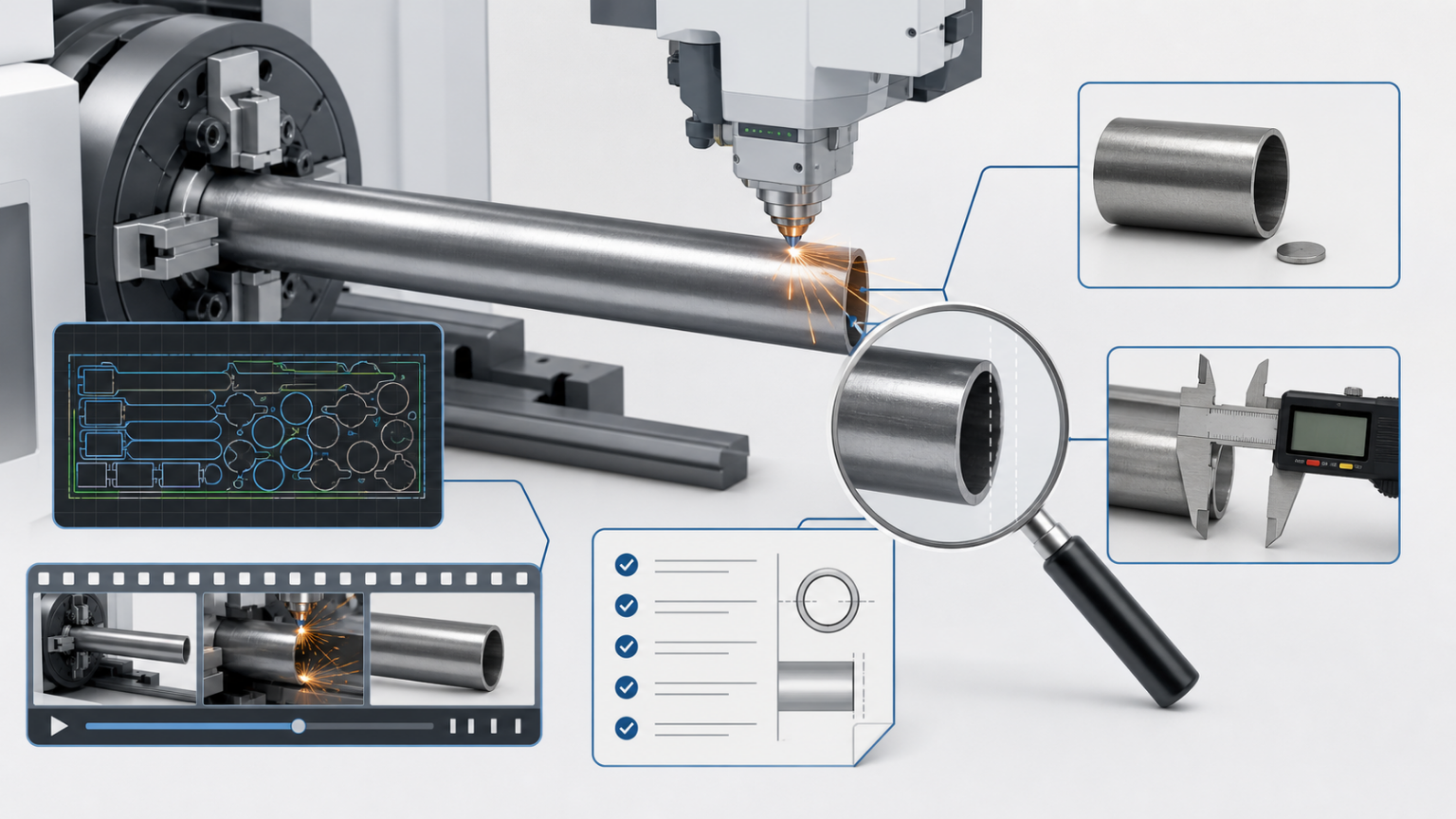
Public evidence can verify whether the supplier publicly presents a zero-tail architecture, but it cannot prove your actual material saving. Buyers should inspect machine layout descriptions, chuck configuration, product videos, nesting examples, part-unloading method, and any public technical documents. These sources can show whether the claim is mechanically plausible, but they do not prove utilization rate, stability, or payback under your production conditions.
Public evidence buyers can inspect
The first useful signal is whether the supplier explains how tail waste is reduced. A generic statement such as “less waste” is weaker than a visible or documented mechanism: rear chuck feeding, front chuck coordination, short remnant control, reverse cutting sequence, or cutting logic that avoids leaving a long unusable tail.
Buyers can also inspect whether product videos show the full cutting sequence, not only the cleanest part of the process. A useful video shows tube loading, chuck gripping, feeding, cutting near the end of the tube, support behavior, remnant handling, and finished part discharge. If the video cuts away before the last section of tube is processed, I would treat the zero-tail claim as incomplete public evidence.
Published product brochures may also reveal whether the machine is designed around ordinary front-first cutting or a more deliberate zero-tail workflow. The buyer should look for clear references to chuck pass-through, grip length, front/rear chuck synchronization, software nesting, and the shortest processable remnant. These are not final proof, but they help separate architecture-based claims from simple marketing language.
| Evidence Type | What It Suggests | What It Does Not Prove |
|---|---|---|
| Machine architecture diagram | The supplier may have a mechanical design intended to reduce dead zones or remnant length. | It does not prove the machine can process your tube profile without vibration, collision, or accuracy loss. |
| Cutting process video | The cutting sequence may be observable, including chuck movement and end-of-tube handling. | It does not prove repeatability across shifts, operators, wall thicknesses, or mixed batches. |
| Nesting example | The supplier may understand material utilization as a software and sequencing issue, not only a cutting-speed issue. | It does not prove the same nesting result for your drawings and order quantities. |
| Published specifications | Some technical limits may be stated, such as tube range or chuck configuration. | It does not prove the usable range under your accuracy and productivity requirements. |
What public evidence does not prove
Public evidence rarely proves the most important commercial question: how much material will your factory actually save. A zero-tail claim may be valid for certain round tubes, standard profiles, long batch runs, or demonstration parts, but less effective for short parts, irregular orders, rectangular tubes, mixed-wall-thickness jobs, or parts that require complex hole patterns near the tube end.
Public information also does not prove the supplier’s nesting software can optimize your real orders. Tail loss is not only a machine-body issue. It depends on part sequencing, common-line opportunities, minimum clamp distance, part orientation, pierce strategy, and whether the machine can safely process the final segment without deformation or collision.
Another limitation is that marketing examples may use ideal raw material lengths and simple part geometry. Buyers should not assume that a public example showing minimal remnant translates into the same result for their project. I would treat it as a starting point, not final proof.
What to request during RFQ
- Your-part nesting report: ask the supplier to nest your actual drawings on your standard raw tube lengths and show expected remnant length, utilization rate, and part sequence.
- End-of-tube cutting video: request an uninterrupted video showing the last section of the tube being processed for a part similar to yours.
- Chuck and dead-zone explanation: ask the supplier to define grip length, non-cuttable zone, minimum processable remnant, and how these vary by tube size.
- Material-saving calculation: require the supplier to show assumptions behind any saving estimate, including raw tube length, batch size, part mix, and scrap valuation.
- Exception cases: ask when zero-tail operation is not available or not recommended, such as thin-wall tubes, heavy profiles, short parts, or special fixtures.
How can buyers verify technical capability through public records or observable proof?
A supplier claims the machine is not only fast but also smarter in cutting logic, yet you cannot tell whether the software, chuck design, and machine control are integrated or simply described separately. If you evaluate only headline cutting speed, you risk selecting a machine that increases throughput in simple jobs while leaving the same tail-waste problem in high-volume production.
Buyers can verify technical capability by looking for observable proof of machine sequence, control logic, mechanical constraints, and documented process limits. Public records and visible demonstrations can suggest whether the supplier has a real zero-tail workflow, but they cannot prove software performance, long-run stability, or savings on the buyer’s exact parts.

Public evidence buyers can inspect
The most useful public proof is a complete process demonstration. A buyer should look for whether the machine cuts from a sequence that reduces remnant waste, whether the rear chuck can continue feeding the tube into the cutting zone, and whether the final part can be completed without leaving a long unusable section.
If public patent records, technical articles, or product manuals are available, they may indicate that the supplier has documented a specific mechanism or control method. However, buyers should avoid overreading such records. A patent or technical description may show an idea exists; it does not prove that the current commercial machine implements it well or that service teams can support it in production.
Observable proof should also include how the machine manages tube support. Reducing tail waste can increase demands on clamping stability, support rollers, unloading, and collision avoidance. A zero-tail machine that cannot maintain accuracy near the end of the tube may save material in theory but create rework or scrap in practice.
| Claimed Capability | Public Signal | Buyer Follow-up Question |
|---|---|---|
| Zero-tail cutting logic | Video or documentation shows special sequencing near the end of the tube. | Does the same logic work for my part lengths, hole positions, and tube profiles? |
| Reduced chuck dead zone | Machine layout suggests minimized non-cuttable length. | What is the actual minimum remnant under each tube size and wall thickness? |
| Integrated nesting software | Product materials mention nesting or material optimization. | Can the supplier provide a nesting report using my production drawings? |
| Stable end-section cutting | Demo shows final tube segment being processed. | What accuracy is maintained on the last parts in a repeated batch test? |
What public evidence does not prove
Public records do not prove the machine can maintain dimensional accuracy while processing the last segment of a tube. Tail-waste reduction is valuable only if the recovered material becomes acceptable parts, not additional scrap. Buyers should ask whether the supplier has measured accuracy separately for parts cut near the tube beginning, middle, and end.
Observable proof also does not prove operator usability. A machine may require careful setup, specific nesting rules, or experienced programming to achieve low waste. If the buyer’s factory runs many small orders or frequent changeovers, the practical benefit may depend as much on software workflow and operator training as on the machine’s physical architecture.
Public evidence cannot confirm service readiness either. Zero-tail cutting involves tighter coordination between chucks, motion control, cutting head position, support systems, and nesting. If local service teams cannot diagnose alignment or software issues quickly, the buyer may face downtime that offsets part of the material-saving benefit.
What to request during RFQ
- Process sequence file: request a sample cutting sequence or simulation for your drawings, showing part order and tube-end handling.
- Accuracy-by-position data: ask for measurement results comparing parts cut at the front, middle, and final section of the tube.
- Software workflow demonstration: require a live or recorded demonstration of importing drawings, nesting parts, generating the cutting path, and calculating remnant.
- Changeover scenario: ask the supplier to demonstrate how the system handles mixed orders, short batches, and different tube profiles.
- Service capability evidence: request the maintenance procedure for chuck calibration, support alignment, software updates, and fault diagnosis.
What risk factors should buyers assess before RFQ?
A supplier presents zero-tail cutting as a direct path to lower cost per part, but you cannot tell whether the saving is larger than the added machine cost, programming complexity, service requirement, or cycle-time tradeoff. If you enter RFQ without defining these risks, you may compare suppliers on price while missing the true cost of ownership.
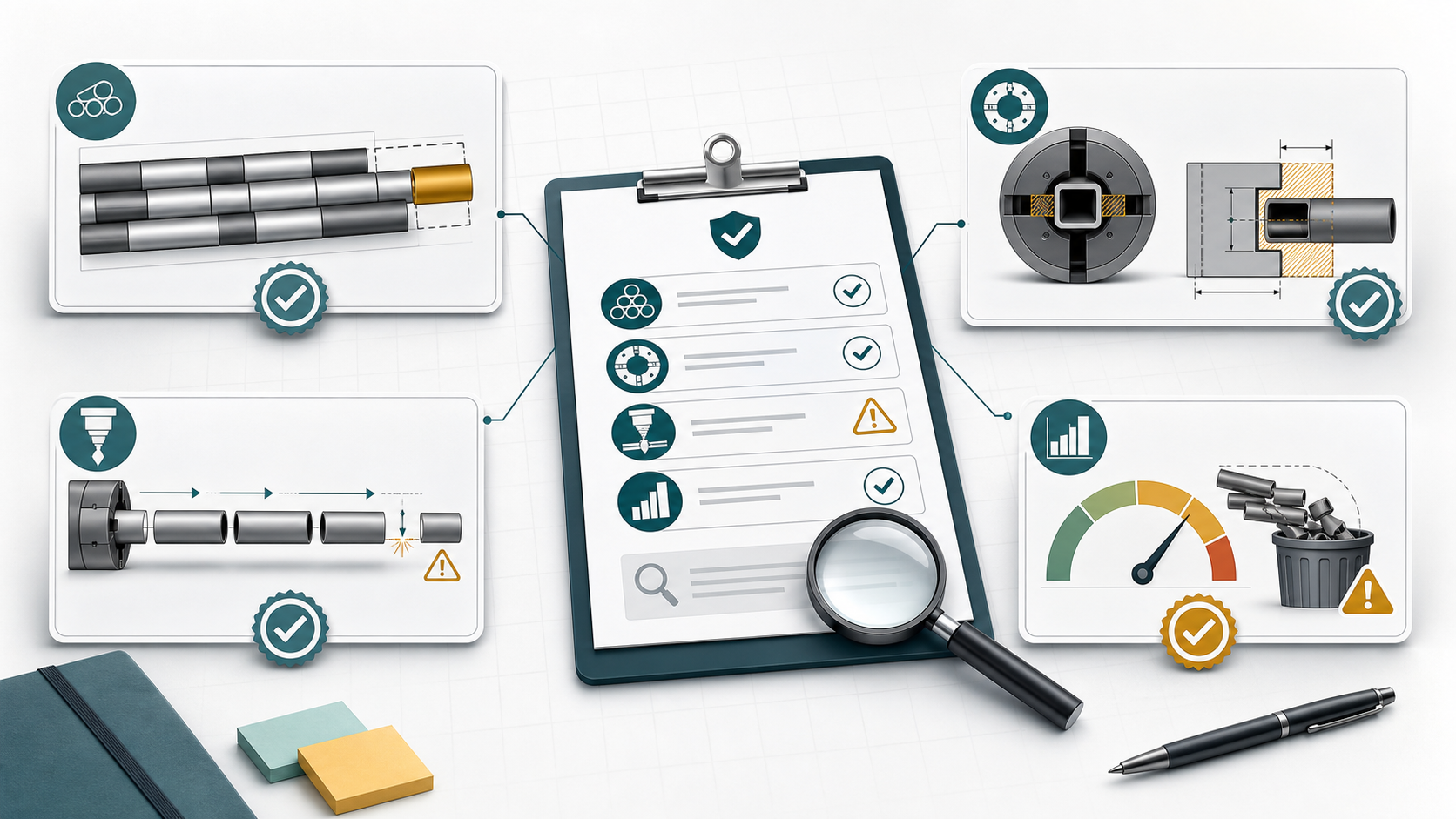
Before RFQ, buyers should assess whether tail waste is a major cost driver in their own production and whether the proposed machine can reduce it without creating new operational losses. Public materials can help identify risk areas such as chuck limitations, dead zones, nesting dependence, tube support, software maturity, and after-sales service, but final evaluation requires project-specific proof.
Public evidence buyers can inspect
The buyer should start by estimating the current tail-waste pattern. This is internal evidence, not supplier evidence. If the factory processes large volumes of similar tubes, even a small remnant per tube may become a meaningful recurring cost. If production is low-volume, highly variable, or dominated by expensive changeovers, the payback may depend on other factors.
Public supplier information can then be checked against the buyer’s risk profile. If the supplier emphasizes laser power and speed but says little about nesting or remnant control, that is a signal to ask deeper questions. If the supplier shows end-of-tube cutting and explains chuck coordination, that is a stronger technical signal, though still not final proof.
Buyers should also assess whether the proposed machine adds complexity. Zero-tail architecture may involve more coordinated motion, stricter calibration, and more dependence on software. This is not automatically negative, but it should be treated as a procurement risk until service, training, spare parts, and maintenance procedures are clarified.
| Risk Factor | Available Public Evidence | Required RFQ Check |
|---|---|---|
| Material-saving uncertainty | Supplier may publish zero-tail claims or demo videos. | Require a savings model based on your tube lengths, drawings, and batch sizes. |
| Accuracy near tube end | Public video may show cutting near the end section. | Request measured samples from first, middle, and final tube positions. |
| Software dependence | Brochure may mention nesting or optimization. | Ask for a live nesting demonstration using your files. |
| Service complexity | Website may list service offices or support promises. | Verify response time, spare parts availability, and technician capability for chuck and control issues. |
| Cycle-time tradeoff | Public specs may show speed or acceleration values. | Ask whether zero-tail sequence changes cycle time compared with standard cutting. |
What public evidence does not prove
Public evidence does not prove economic payback. A machine can reduce tail waste and still fail to meet the buyer’s return expectations if it is slower, more expensive to maintain, harder to program, or underused due to poor fit with the factory’s production mix.
Public information also does not prove that every profile can be processed with the same efficiency. Round, square, rectangular, oval, angle, and channel profiles may behave differently under clamping and support. Wall thickness, straightness, weld seam orientation, and tube surface condition can also affect stability and accuracy.
Another risk is overgeneralized comparison. A faster machine is not necessarily a more profitable machine if material utilization remains poor. Conversely, a machine with strong utilization logic may not be justified if the buyer’s tail-waste cost is small. The evaluation should connect technical capability to the buyer’s cost structure.
What to request during RFQ
- Baseline waste audit: calculate your current average remnant per tube by product family before asking suppliers for savings claims.
- Profile-specific limits: ask the supplier to state zero-tail availability separately for each tube type, size, wall thickness, and material grade.
- Cycle-time comparison: request standard-cutting and zero-tail-cutting cycle estimates for the same sample order.
- Operating-cost assumptions: ask for consumables, maintenance intervals, chuck wear items, calibration needs, and software license conditions.
- Acceptance criteria: define what counts as acceptable proof: utilization rate, dimensional tolerance, edge quality, batch completion time, and scrap rate.
How should buyers structure unresolved checks in supplier evaluation?
A supplier claims zero-tail cutting, intelligent nesting, stable final-section cutting, and fast payback, but you cannot verify these claims completely from public records. If you treat unresolved claims as proven facts, you risk locking technical uncertainty into the purchase contract and discovering the real limits only after installation.
Buyers should convert every unsupported claim into a specific RFQ question, document request, sample test, or supplier demonstration. Public evidence can classify a claim as plausible, partially supported, or unsupported, but it does not replace project-specific verification using the buyer’s drawings, materials, tolerances, and production volumes.
Public evidence buyers can inspect
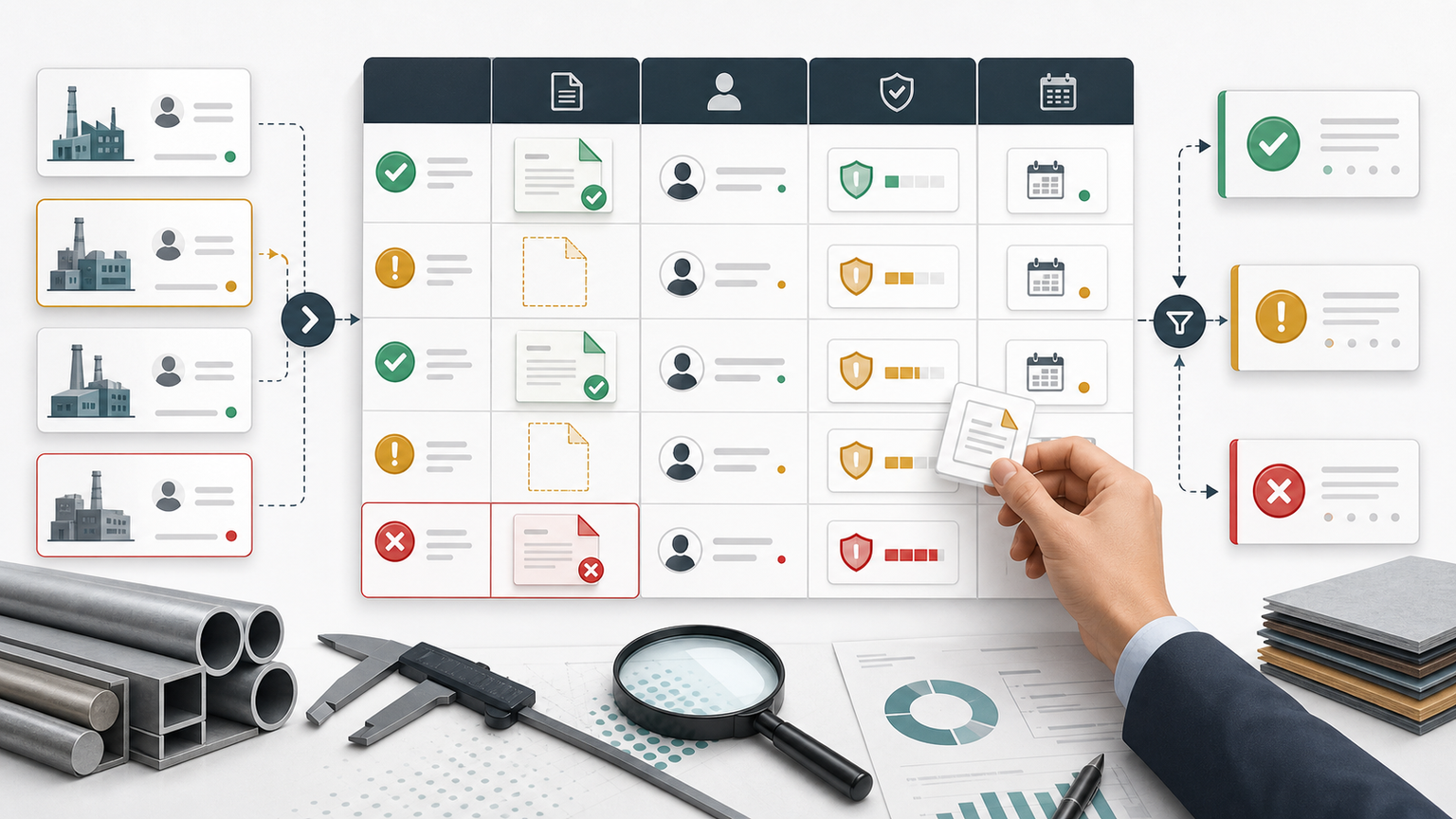
The buyer can create an evidence matrix before RFQ. For each supplier claim, mark whether public materials provide clear evidence, partial evidence, or no evidence. This keeps the evaluation disciplined and prevents a sales phrase from becoming an assumed technical fact.
Publicly observable evidence may include videos, machine layout, technical descriptions, sample part images, software screenshots, trade-show demonstrations, and published support information. These can help decide which suppliers deserve deeper RFQ engagement. They should not be used to finalize the award.
The most important step is to write RFQ questions in a way that requires measurable answers. Instead of asking “Can the machine do zero-tail cutting?”, ask for a nesting report, minimum remnant value by profile, sample cutting video, utilization calculation, and exceptions list. The quality of the supplier’s answer is itself a procurement signal.
| Supplier Claim | Public Evidence Status | Required RFQ Check |
|---|---|---|
| The machine can achieve zero-tail cutting | May be partially supported by public videos or product descriptions, but not proven for the buyer’s parts. | Request a full cutting demo using the buyer’s tube size, raw length, and drawing set. |
| Nesting software improves material utilization | Public software screenshots or claims may exist, but project-specific optimization is unresolved. | Require a nesting report comparing current process, standard cutting, and proposed zero-tail logic. |
| The final tube section remains accurate | Public demonstrations may show cutting near the end, but measurement evidence is usually not public. | Request inspected samples from the final section with measurement records. |
| The machine provides fast payback | Public claims may be supplier estimates and should not be treated as verified. | Require a payback calculation using buyer-supplied volume, material cost, scrap rate, labor, and uptime assumptions. |
| The system is easy to operate | Public interface images or demo videos may suggest usability, but not training burden. | Request operator workflow demonstration and training plan for the buyer’s team. |
What public evidence does not prove
Public evidence does not prove daily execution. Even if a supplier demonstrates one successful zero-tail cut, the buyer still needs evidence of repeatability, setup time, operator learning curve, and maintenance sensitivity.
Public evidence also does not prove contractual accountability. If the purchase agreement only states general capability but does not define sample parts, tolerance, utilization targets, and acceptance tests, the buyer may have limited leverage if the installed machine performs below expectation.
Finally, public materials do not prove the supplier’s internal engineering depth. A good-looking product page may not show whether the supplier can solve application problems, modify nesting logic, support unusual profiles, or train the buyer’s programming team.
What to request during RFQ
- Claim-to-evidence matrix: list each supplier claim and require the supplier to attach proof, not just repeat the claim.
- Buyer-part sample test: provide representative drawings and require a test plan showing raw tube length, nesting, cutting sequence, and inspection method.
- Acceptance test protocol: define utilization, tolerance, edge quality, cycle time, and maximum allowed remnant before issuing a purchase order.
- Exception disclosure: ask the supplier to state when zero-tail cutting is unavailable, slower, less accurate, or dependent on special setup.
- Contract attachment: include the agreed test results, limits, and acceptance criteria as part of the commercial record.
| Evidence Type | What It Suggests | What It Does Not Prove |
|---|---|---|
| Supplier demonstration | The machine may be capable under selected conditions. | It does not prove performance across all buyer parts or production shifts. |
| Sample nesting report | The software may produce a plausible utilization plan. | It does not prove shop-floor execution without cutting and inspection. |
| Inspection record | The sample part may meet tolerance in one test. | It does not prove repeatability without a batch test. |
| Training plan | The supplier recognizes operator workflow as part of implementation. | It does not prove the buyer’s operators can sustain the result without support. |
What are the limits of public evidence for this buying decision?
A supplier’s website may show modern equipment, clean sample parts, and confident claims about zero-tail cutting, but you cannot tell whether those materials reflect normal production, selected demonstrations, or conditions unlike your own factory. If you rely on public evidence as final proof, you risk confusing visibility with verification.
Public evidence is useful for screening suppliers, but it cannot prove real operational performance, economic return, or project fit. Buyers should use public information to identify plausible suppliers and technical questions, then require RFQ-stage data, sample cutting, factory audit evidence, and contractual acceptance criteria before making the buying decision.
Public evidence buyers can inspect
Public evidence can establish a baseline. A supplier that clearly explains chuck architecture, cutting logic, nesting approach, and application limits gives buyers more to evaluate than a supplier that only claims “high efficiency” or “low waste.” This does not prove superiority, but it improves transparency.
Buyers can also inspect whether the supplier communicates constraints. A credible technical discussion usually acknowledges that machine performance depends on tube type, part geometry, wall thickness, support method, nesting strategy, and operator setup. A supplier that never discusses limits should be asked to define them during RFQ.
Factory images, videos, trade-show demonstrations, and public case summaries may help buyers understand the supplier’s market focus and technical positioning. However, without project-specific data, these remain screening signals.
| Public Signal | What Buyers Can Infer | What Remains Unresolved |
|---|---|---|
| Clear machine sequence video | The supplier may have a real process for reducing tail waste. | Whether the process works for the buyer’s parts and tolerances. |
| Technical explanation of chuck design | The supplier may understand the mechanical cause of tail waste. | Actual minimum remnant and accuracy under buyer conditions. |
| Nesting or software discussion | The supplier may treat utilization as a programming issue. | Whether the software improves the buyer’s real order mix. |
| Service and training information | The supplier may have implementation support capability. | Whether local support is fast and competent enough for the buyer’s site. |
What public evidence does not prove
Public evidence cannot prove uptime, operator discipline, service response, spare-parts availability, or long-term maintenance cost. These are often decisive in procurement, but they are rarely visible from public materials alone.
It also cannot prove that the machine will reduce total cost per part. Tail-waste reduction must be weighed against purchase price, financing cost, floor space, energy use, assist gas, consumables, programming time, training, maintenance, and utilization rate. A narrow material-saving claim is not the same as a full business case.
Most importantly, public evidence cannot replace acceptance testing. For a high-volume buyer, the only meaningful proof is a controlled test using representative parts and a documented pass/fail method.
What to request during RFQ
- Representative batch trial: require a batch test large enough to show repeatability, not a single showcase cut.
- Documented assumptions: ask the supplier to state every assumption behind utilization, cycle time, and payback estimates.
- Factory audit agenda: include chuck calibration, nesting workflow, spare parts, service records, training process, and quality inspection.
- Performance guarantee language: define what performance must be proven before final acceptance and payment milestones.
- Residual-risk log: record what remains uncertain even after sampling, and decide whether the risk is commercially acceptable.
Conclusion: How should buyers make the final judgement?
The practical method is to separate supplier claims into three groups: publicly supported signals, partially supported signals, and unresolved checks. For zero-tail tube cutting, public evidence can help buyers judge whether the supplier appears to have relevant architecture, cutting logic, and nesting awareness. It cannot prove the actual saving, tolerance stability, cycle time, or payback for a specific factory.
I would treat public information as a qualification baseline, not a final procurement decision. A machine that claims zero-tail cutting still needs to prove its value through buyer-part nesting, end-of-tube sample cutting, measurement records, cycle-time comparison, exception disclosure, and service-readiness checks.
Before RFQ, document what is already verified, what is uncertain, and what evidence the supplier must provide. The strongest evaluation is not based on whether the machine is described as “zero-tail,” but whether the supplier can prove, with your drawings and production assumptions, that reduced tail waste becomes acceptable parts and measurable cost improvement.